From San Marino to Liechtenstein. How Europe’s Microstates Navigate Integration Without EU Membership?
Liechtenstein, Andorra, San Marino, Monaco and Vatican City show how far EU rules extend beyond membership - and where the smallest states draw the line.
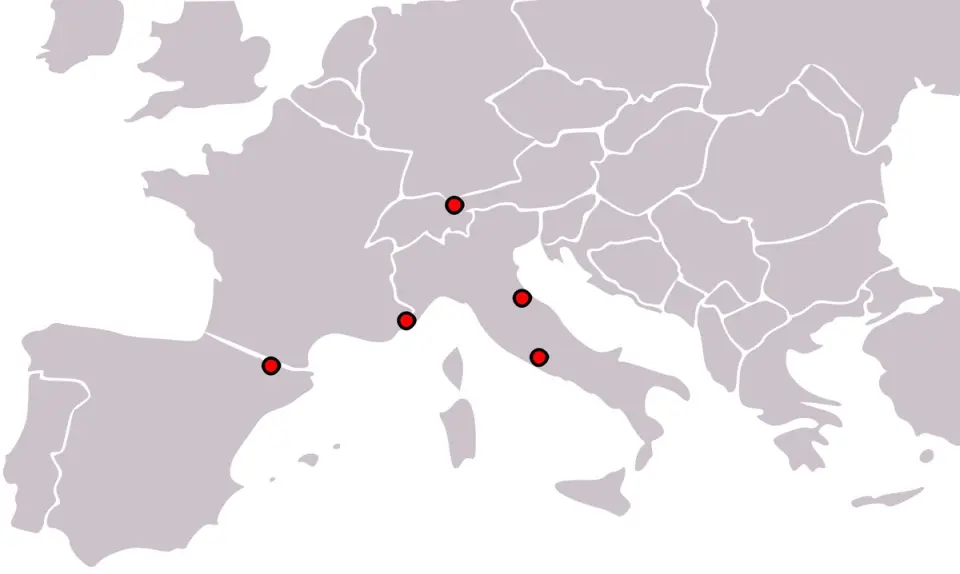
From San Marino to Liechtenstein: How Europe’s Microstates Navigate Integration Without EU Membership
Liechtenstein, Andorra, San Marino, Monaco and Vatican City show how far EU rules extend beyond membership - and where the smallest states draw the line
Autor: Mateusz Miziołek
Editor: Kamil Rak
The puzzle of integration without membership
The relationship between the European Union and the smallest states on the continent is one of the more intriguing, and frequently overlooked, facets of European integration. Five of the tiniest states in the world - Liechtenstein, Andorra, San Marino, Monaco and Vatican City - lie within Europe, and although none of them belongs to the Union, each is bound to it to a markedly different degree. Some have secured access to much of the internal market, whereas others maintain only a narrow arrangement: on 19 October 2026 the EU signed an Association Agreement with Andorra and San Marino, opening the internal market to both without conferring membership, while Liechtenstein has participated in that market since 1995 through the European Economic Area, Monaco suspended its own negotiations in September 2023, and Vatican City’s ties amount to little more than a monetary agreement. The aim of this article is to delineate why five such comparable neighbours, confronted with essentially the same Union, have arrived at such divergent positions. I would contend that the EU is able to extend its rules well beyond its membership, yet the depth of integration each state accepts is ultimately determined by its own priorities and by its capacity to implement the obligations involved - and that, for most of these states, the most sensitive of those obligations concerns the movement and residence of people.
How does the comparison work?
Two concepts underpin the analysis that follows. The first is external governance: the process through which the Union extends its rules and standards beyond its borders and thereby shapes the conduct of states that are not members. The second is differentiated integration, which denotes the varying degrees and forms in which non-members take part in European integration. Taken together, these concepts explain how a state may come to adopt EU law, and to accept the authority of the Court of Justice of the European Union (CJEU), without ever casting a vote in the institutions that produce those rules.
It would be a mistake, however, to equate the absence of a formal vote with the absence of influence. Small states can negotiate exceptions, operate through joint institutions and shape the way rules are applied. In comparing the five cases, I therefore examine five dimensions: the market access each arrangement confers, the EU rules each state must adopt and the manner in which compliance is supervised, the formal or informal influence each retains, the domestic interests that set its limits, and the administrative capacity required to meet the obligations. The aim is not merely to describe five relationships, but to explain why they have diverged so markedly.
Liechtenstein: the deepest relationship
Liechtenstein has advanced furthest of the five. Through the EEA it has incorporated the greater part of the Union’s internal-market law and continues to adopt new rules as they emerge. Its participation, however, should not be conflated with membership: the EFTA Surveillance Authority and the EFTA Court supervise the EEA EFTA states, and Liechtenstein enjoys a right to be consulted while relevant legislation is being drafted - a prerogative commonly termed decision-shaping. This affords it a voice in the formulation of the rules, though not a vote on their final content.
The movement of persons has constituted the one salient exception. Given how small its territory and population are, Liechtenstein was unwilling to allow unrestricted settlement to transform its society, and it secured a special arrangement within the EEA framework permitting it to cap the number of EEA nationals taking up residence. This is a carefully circumscribed qualification of free movement rather than a repudiation of the single market, and it illustrates a broader point: deep integration can coexist with a negotiated safeguard precisely where a state deems a particular obligation too sensitive to accept in full.
Andorra and San Marino: an agreement adapted to their size
For Andorra and San Marino the Union devised a different instrument. The Association Agreement they signed on 19 October 2026 is intended to open the internal market while accommodating their particular circumstances; unlike Liechtenstein, they do not accede to the EEA. It encompasses the movement of goods, services, people and capital, subject to its conditions, while access to financial services is to be introduced gradually and made contingent on assessments of each state’s regulatory and supervisory systems.
Moreover, the agreement obliges both states to incorporate relevant EU rules as those rules evolve, and it assigns the CJEU a role in interpreting EU law and resolving disputes. Protracted transitional periods - extending to thirty years for certain Andorran tobacco arrangements - acknowledge that small administrations and exposed sectors require time to adapt. Even so, this is not membership because neither state obtains a vote in the institutions that adopt the rules it will be bound to apply.
Their formal influence warrants the same careful description. The agreement establishes joint institutions, among them a joint parliamentary committee, together with procedures for the settlement of disputes. On the information publicly available, it does not appear to grant Andorra and San Marino a decision-shaping prerogative equivalent to Liechtenstein’s under the EEA. This is a difference in formal machinery, not evidence that the two states will wield no influence in practice; the very fact that they negotiated transition periods and safeguards demonstrates that they can shape the terms of their relationship.
The movement of people likewise runs through the agreement. Andorran and San Marinese citizens are to acquire rights associated with the internal market, while the text also contains specific provisions on residence and implementation. Andorra retains a measure of control over the issuing of residence permits, and neither state joins the Schengen area through this agreement. The precise effects must be read against the provisions themselves, rather than reduced to a simple assertion that free movement is either wholly accepted or wholly rejected.
Signature, moreover, is not the conclusion of the process. The agreement is not yet in force: the European Parliament must give its consent, the Council must conclude it, and, because it reaches into areas of member-state competence, national parliaments must ratify it as well. Andorra faces further domestic procedures of its own. Provisional application and full entry into force therefore depend on additional legal stages, and the agreement’s practical significance will emerge only over time.
Monaco: the state that declined to proceed
Monaco negotiated alongside the other two, but in September 2023 the talks were suspended by mutual agreement, following its own assessment of what closer integration would entail. This was a suspension rather than a formal withdrawal; when the agreement with Andorra and San Marino was signed in 2026, Monaco was simply not party to it.
The obstacle lay in the implications of integration for Monaco’s domestic arrangements, above all those governing residence and employment. The principality is exceedingly small, the majority of its residents are foreign nationals, and its economic and social model rests on preferences affecting access to housing and work. To open the territory to the full logic of an association agreement would therefore have entailed far more than a technical adjustment, and Monaco elected, for the time being, not to proceed - retaining its existing relationship with France and its use of the euro under its monetary arrangement with the Union. The case makes a plain point: access to the internal market is not invariably sufficient to secure a state’s acceptance of a wider array of obligations. A government may conclude that the domestic price exceeds the anticipated reward.
Vatican City State: a different kind of relationship
Vatican City belongs in this comparison only at its outermost edge, and it requires one distinction to be situated correctly. The Holy See conducts the Vatican’s international relations, whereas Vatican City State is the state in international law. The monetary agreement with the EU concerns the use of the euro by Vatican City State and is concluded through the representation of the Holy See under the relevant arrangements; concluded in 2009 and in force from 2010, it permits the use of the euro and the minting of a limited number of coins.
This relationship differs fundamentally from the others. Vatican City seeks no broad access to the internal market and possesses nothing resembling the economy or labour market of the remaining four. Questions concerning the adoption of single-market legislation, the regulation of cross-border workers or the shaping of internal-market rules scarcely arise. Its monetary agreement should not be mistaken for a diminished association agreement; it serves a far narrower purpose.
What the comparison shows
First and foremost, the comparison reveals the terms on which the Union extends its rules beyond its membership. The EU is prepared to offer access to its market, yet that access is inseparable from obligations - the adoption of its rules and the acceptance of arrangements for their interpretation and supervision. What differs between the cases is the machinery through which these obligations are managed: Liechtenstein benefits from the EEA’s decision-shaping process, whereas Andorra and San Marino rely on a distinct set of joint bodies and legal procedures. The distinction is pivotal, for participation in a market does not, of itself, confer any formal role in the making of its rules.
Nonetheless, the absence of a vote does not render the smaller states powerless. Liechtenstein’s special arrangement, and the transitional periods secured by Andorra and San Marino, demonstrate that the terms of integration can be adjusted. The Union retains the basic structure of the relationship, but its partners can negotiate how and when particular obligations take effect. This is influence exercised through negotiation rather than equal participation in EU decision-making.
A second consideration concerns the limits that domestic priorities impose on integration. The movement and residence of people weigh most heavily on Liechtenstein and Monaco, albeit to opposite effect: Liechtenstein obtained a safeguard and remained closely integrated, whereas Monaco declined the agreement altogether. Andorra retains specific controls over residence permits under the new arrangement. The evidence concerning San Marino is more tenuous, and I would not simply presume its concerns to mirror Andorra’s. For Vatican City the question is largely immaterial, since its relationship serves a wholly different purpose.
Administrative capacity constitutes a third consideration. The protracted transitions and the phased treatment of financial services suggest that the implementation of EU law can impose a genuine strain on a very small administration. This is not to imply that microstates are incapable of meeting demanding obligations; rather, the timing and the institutional support they require can determine which kind of agreement is workable at all.
The limits of integration without membership
In the light of the above, I would pinpoint that integration without membership is neither simply imposed by Brussels nor freely chosen by the partner state without constraint. The Union establishes the basic terms of access to its internal market and expects those who accept that access to adopt the corresponding rules. The microstates, for their part, determine how far they are willing to go, negotiate exceptions where they can, and may decline an agreement altogether when its domestic costs prove too high.
The underlying point is that the depth of integration is underpinned not merely by the economic benefits on offer, but by the distribution of authority, the sensitivity of domestic policy and the sheer capacity to implement common rules. For some of these states the decisive limit is the question of who may live and work on their territory; for others it is administrative capacity, or a far narrower objective, as in the case of Vatican City. These are small states, yet their experience illuminates a broader feature of European integration: the Union can extend its rules a considerable distance beyond its borders, but it cannot presume that every neighbour will accept the same bargain. Integration without membership is, ultimately, a negotiated compromise - the Union stipulating the conditions of entry, and each state deciding which obligations it can accept, and where it must draw the line.
Sources
- Bloomberg (2023), “Monaco, EU Suspend Talks for Closer Ties on Housing, Work Clash”, 15 September 2023.
- Council of the European Union (2013), Conclusions on EU relations with the Principality of Andorra, the Principality of Monaco and the Republic of San Marino, 16 December 2013.
- European Commission (2026), statement on the signature of the EU Association Agreement with Andorra and San Marino, 19 October 2026.
- European Economic Community (1990, 1991), agreements concerning Andorra and San Marino.
- European Parliamentary Research Service (2024), EU association agreement with Andorra and San Marino, Briefing EPRS_BRI(2024)766263. https://www.europarl.europa.eu/RegData/etudes/BRIE/2024/766263/EPRS_BRI(2024)766263_EN.pdf (https://www.europarl.europa.eu/RegData/etudes/BRIE/2024/766263/EPRS_BRI(2024)766263_EN.pdf?utm_source=chatgpt.com)
- European Union, Agreement on the European Economic Area, and relevant arrangements concerning the movement of persons in Liechtenstein.
- European Union (2024), Association Agreement between the EU, the Principality of Andorra and the Republic of San Marino, Council document ST-11787-2024-REV-1.
- Gstöhl, S. (2002), Reluctant Europeans: Norway, Sweden, and Switzerland in the Process of Integration, Lynne Rienner.
- Lavenex, S. and Schimmelfennig, F. (2009), “EU rules beyond EU borders: theorizing external governance in European politics”, Journal of European Public Policy, 16(6).
- European Union, monetary agreements with Andorra, San Marino, Monaco and Vatican City State, concluded under Article 219(3) TFEU.
- San Marino (2013), referendum on an EU membership application, 20 October 2013.
- Schimmelfennig, F. and Winzen, T. (2020), Ever Looser Union? Differentiated European Integration, Oxford University Press.
- Steinmetz, R. and Wivel, A. (eds.) (2010), Small States in Europe: Challenges and Opportunities, Ashgate.
- Tomášek, M. (2025), “Customs and Monetary Relations Between the European Union and Neighboring Microstates”, The Lawyer Quarterly, No. 3/2025, pp. 281–293.
- 01The puzzle of integration without...
- 02How does the comparison work?
- 03Liechtenstein: the deepest relationship
- 04Andorra and San Marino: an agreement...
- 05Monaco: the state that declined to...
- 06Vatican City State: a different kind of...
- 07What the comparison shows
- 08The limits of integration without...
- 09Sources
Absolwent lingwistyki stosowanej (języki niemiecki i szwedzki) na Uniwersytecie Warszawskim, obecnie student magisterski języków nordyckich na Uniwersytecie w Uppsali. Jego zainteresowania sytuują się na pograniczu dyplomacji i językoznawstwa. Pracę magisterską pisze po szwedzku, poświęcając ją wielojęzyczności organizacji międzynarodowych - porównuje w niej polityki językowe Unii Europejskiej i ONZ. Zapalony tenisista, miłośnik klasycznego kina i namiętny słuchacz hip-hopu, a przede wszystkim pasjonat języków obcych.
Sprawdź podobne publikacje
Wszystkie publikacje
The EU’s Interests in Arctic Security at Europe’s Northern Edge
This article examines how the Union pursues security in a region where it holds territory but no seat, and argues that in the High North the EU’s influence stems not from membership but from partnership - and that partnership, however close, confers influence rather than control.

Mirrored in multilateralism - how does the European Union speak without a vote in the United Nations?
How an european union of states that casts no ballot became a significant presence in the UN system, and why its member states’ coherence now matters more than before.

Między Kongresem a Białym Domem. Wpływ wyborów midtermowych w USA w 2026 roku na relacje transatlantyckie
Listopadowe wybory midtermowe w Stanach Zjednoczonych odbędą się w momencie, gdy relacje transatlantyckie mierzą się z szeregiem wyzwań, a ich wynik może wpłynąć na dalszy kształt współpracy USA z Europą. Zmiana układu sił w Kongresie może ograniczyć swobodę działania administracji Donalda Trumpa, ale czy wystarczy, by zmienić amerykańskie podejście do Europy?